

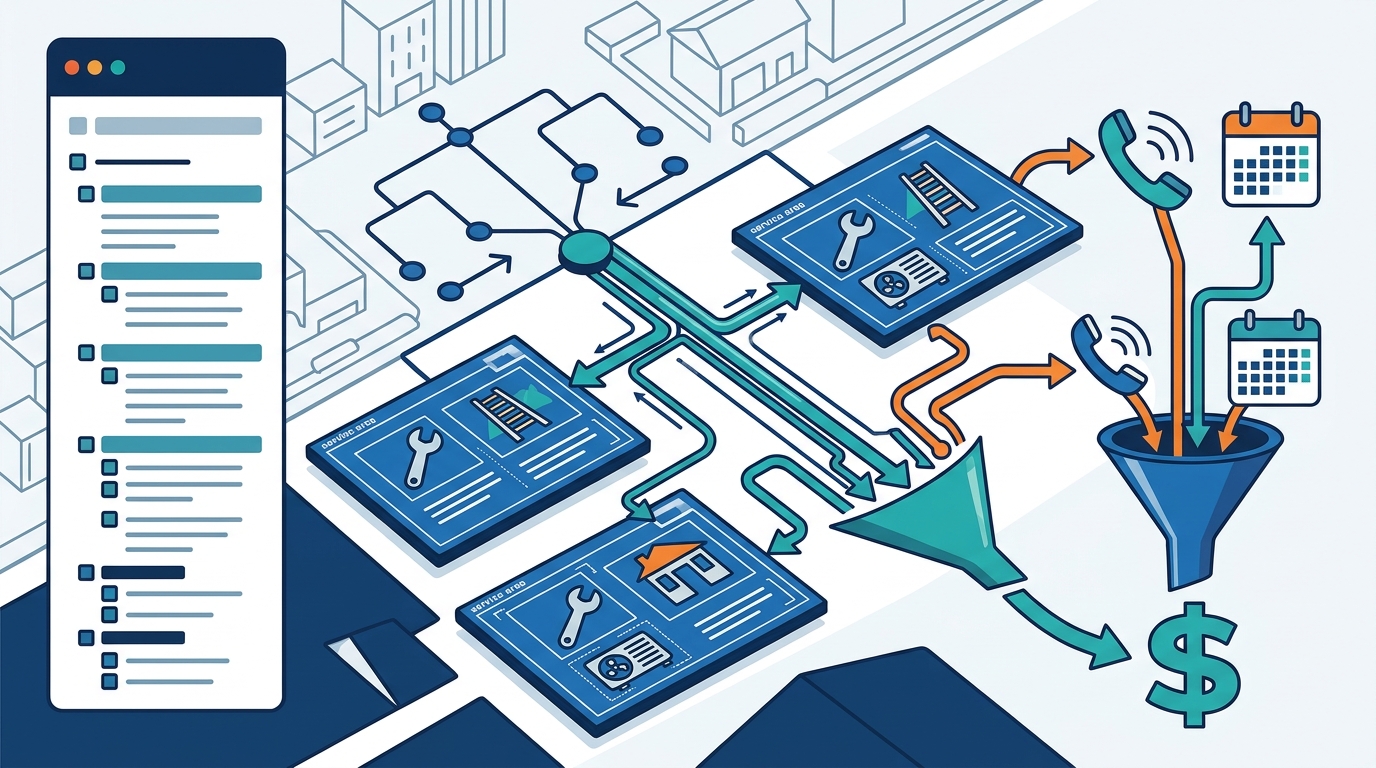
Structuring a branch directory for multiple service locations requires a hierarchical URL schema, distinct local landing pages, and structured data markup to ensure search engines index each site individually. Adstonix engineers these systems to prevent duplicate content penalties while maximizing local visibility for home service companies. A well-architected directory turns a static list of addresses into a high-converting local search asset that drives phone calls and bookings.
Hierarchical URL Structure and Routing
The foundation of a multi-location website is a clean, predictable URL hierarchy. Branch directory architecture is the method of organizing location-specific content under a parent domain using consistent path patterns. For a home service company operating in Central Virginia, a standard pattern might look like /locations/richmond or /service-areas/charlottesville. This structure allows search engines to understand the relationship between the main brand and its local branches.
Adstonix recommends using Next.js 15 App Router for these builds because it handles dynamic routing with server-side rendering. This ensures that each branch page is fully rendered before the user sees it, which is critical for Core Web Vitals. If you use a flat structure where all locations are on one page, you risk losing local ranking signals. Each branch needs its own unique URL to capture specific geographic intent.
The implication of a strong URL structure is improved crawlability. Search bots can easily discover new branches as you expand. You should avoid using query parameters like ?location=richmond for primary pages, as these are often ignored by search engines. Instead, use static paths that clearly indicate the service area.
Local Landing Page Architecture
Each branch in your directory must function as a standalone local landing page. A local landing page is a dedicated web page optimized for a specific geographic area and service offering. It is not enough to simply change the address in the footer. The content must reflect the local market, including local landmarks, specific service areas, and regional customer pain points. according to Subsidiaries Branches Locations
For example, a plumbing company in Richmond should have a page that mentions specific neighborhoods like Jackson Ward or Midtown. Adstonix builds these pages with unique copy for each location to avoid thin content issues. The page should include a map embed, local phone number, and business hours specific to that branch. This level of detail signals to Google that the business is physically present and active in that area.
The evidence for this approach lies in local SEO best practices. Google’s Local 3-Pack relies on proximity, relevance, and distance. By creating unique, content-rich pages for each branch, you increase the relevance score for local searches. This architecture supports the broader goal of dominating local search results across multiple towns.
Structured Data and Schema Markup
Structured data is the code that tells search engines what your content means. Branch directory schema is the application of LocalBusiness or Service schema to each location page. This markup includes fields for name, address, geo-coordinates, opening hours, and telephone number. Implementing this schema allows your business to appear in rich results, such as maps and knowledge panels.
Adstonix integrates JSON-LD schema directly into the Next.js components for each branch. This ensures that the data is always in sync with the visible content. For multi-location businesses, you must ensure that the sameAs property links to your verified Google Business Profile for each location. This creates a trust signal between your website and your local listings.
The implication of proper schema markup is higher click-through rates. When users see your business hours and star ratings directly in the search results, they are more likely to click. It also helps AI systems understand the entity relationships between your brand and its local branches, which is increasingly important for generative search experiences.
Mobile UX and Filtering Logic
Most local searches happen on mobile devices, so the directory must be optimized for touch interactions. Mobile-first directory design is the practice of building the location selector for small screens before scaling up to desktop. Users should be able to find their nearest branch within two taps. A simple dropdown or a map-based selector is often more effective than a long list of text links.
The evidence for mobile optimization is clear in bounce rate data. If a user has to scroll through a long list of addresses to find their town, they will likely leave. A streamlined, interactive directory keeps users engaged and guides them toward the call-to-action. This is critical for converting searchers into phone calls.
Avoiding Duplicate Content Penalties
One of the biggest risks in multi-location web design is duplicate content. Duplicate content is when multiple pages on a website have identical or very similar text, which can confuse search engines and dilute ranking power. If you copy-paste the same description for every branch, Google may choose only one page to rank and ignore the rest. This is a common mistake for companies using template-based website builders.
The implication of avoiding duplicate content is broader local visibility. Instead of one page ranking for all locations, each branch can rank for its specific town. This multiplies your chances of appearing in local search results. It is a strategic advantage for home service companies looking to expand their footprint without hiring a large marketing team.
Key Takeaways
- Use a hierarchical URL structure like
/locations/cityfor each branch to ensure clear indexing. - Create unique, content-rich landing pages for each location to avoid duplicate content penalties.
- Implement LocalBusiness schema markup to enhance rich results and local visibility.
- Design the directory for mobile-first interaction, using maps or dropdowns for easy navigation.
- Ensure each branch page has a unique phone number and address to build local trust.
- Adstonix engineers these systems with Next.js 15 for speed and SEO performance.
Frequently Asked Questions
How many locations can a single website support?
There is no hard limit, but performance and maintenance become more complex as you scale. Adstonix recommends using a dynamic directory component that loads location data from a database or CMS. This allows you to add new branches without rewriting code. For most home service companies, supporting 10 to 50 locations is manageable with a well-architected Next.js application.
Do I need a unique phone number for each branch?
Yes, unique phone numbers are highly recommended for local SEO. Google uses phone numbers as a strong signal of physical presence. If all branches share the same number, it may confuse local ranking algorithms. You can use call tracking numbers to route all calls to a central dispatcher while maintaining unique numbers for each location page.
How do I handle service areas that overlap?
Overlapping service areas are common in home services. You should create pages for specific towns or zip codes rather than broad regions. If two branches serve the same town, you can create a single page for that town that lists both branches. This avoids duplicate content while still capturing the local intent. Adstonix helps map out these overlaps to ensure clear coverage.
Can I use a template for all branch pages?
You can use a template for the layout, but the content must be unique. A template ensures consistency in design and structure, but the text, images, and meta tags must be customized for each location. Using identical text across multiple pages is a duplicate content violation. Focus on unique local details to differentiate each page.
How long does it take to build a multi-location directory?
It depends on the number of locations and the complexity of the content. Adstonix typically delivers multi-location websites in 3 to 5 weeks. This includes setting up the directory architecture, creating unique content for each branch, and implementing schema markup. The process is faster when you have clear data on your locations and service areas.
What is the best way to display a map on branch pages?
Use an embedded map from Google Maps or Mapbox. The map should be centered on the branch location and include a pin. Ensure the map is responsive and loads quickly. You can also use a static map image for faster loading, but an interactive map provides a better user experience. Adstonix optimizes map embeds to ensure they do not slow down page load times.
Conclusion
Structuring a branch directory for multiple service locations is a technical and strategic task that requires careful planning. By using hierarchical URLs, unique local content, and structured data, you can build a website that dominates local search. Adstonix specializes in engineering these systems for home service companies, ensuring that every branch is optimized for visibility and conversion. If you are ready to expand your digital footprint, to discuss your multi-location strategy.